Carolina Herrera Brings a Venezuelan Fashion Legacy to Miami’s Design District
There are fashion names we admire for what they create, and then there are designers whose influence becomes part of how generations of women understand style.
For Miami Fashion Spotlight, the opening of the new Carolina Herrera Miami Design District flagship feels especially meaningful.
Carolina Herrera is Venezuelan, and so is the founder of Miami Fashion Spotlight. For Venezuelan women who grew up loving fashion, Herrera has long represented something larger than a successful international designer. She became proof that a woman from Venezuela could build a fashion language recognized around the world without sacrificing elegance, femininity or her own unmistakable point of view.
And then, of course, there is the white shirt.
Few designers have elevated such a familiar wardrobe piece with the consistency and authority of Carolina Herrera. Crisp, sophisticated and seemingly effortless, the white shirt became one of the enduring symbols associated with her personal style and fashion legacy.
For many of us, it remains one of those pieces a wardrobe simply should not be without.
Now, that legacy has a significant new home in Miami.
Carolina Herrera Opens a New Miami Design District Flagship
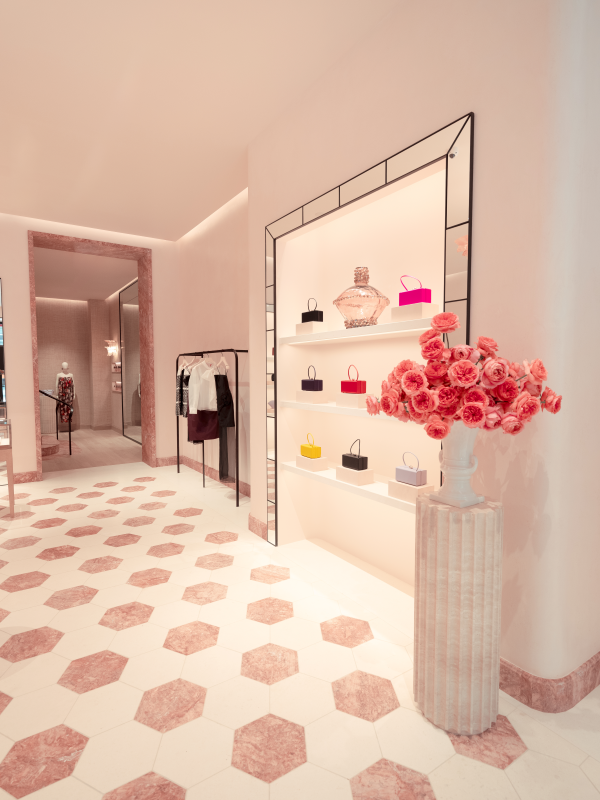
Carolina Herrera officially opened its new flagship boutique in the Miami Design District on August 15, 2026, introducing nearly 3,000 square feet dedicated to the complete universe of the New York-based fashion house.
The opening represents the House’s sixth boutique in the United States and arrives during an important year: Carolina Herrera is celebrating its 45th anniversary.
The new location brings ready-to-wear, eveningwear, handbags, accessories, beauty, fragrance and eyewear together under one roof, creating something considerably more immersive than a traditional retail experience.
For its debut, the boutique welcomes clients with the Fall 2026 runway collection, inspired by Women in the Arts, alongside the House’s newly introduced handbag collection.
It is a fitting combination for a space where fashion and art have intentionally been designed to coexist.
A Herrera Point of View Meets the Energy of Miami
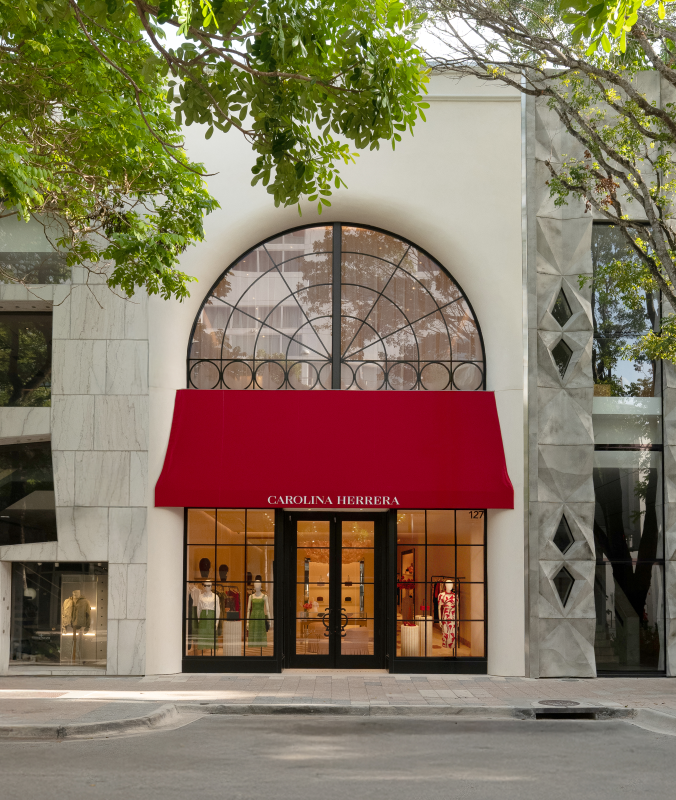
The Miami Design District has become one of the city’s most recognizable intersections of international fashion, contemporary architecture, art and luxury.
Carolina Herrera’s arrival feels particularly natural within that environment.
President Emilie Rubinfeld described the opening as an important milestone for the brand during its 45th year and the result of several years spent identifying the right Miami location.
The objective was not simply to create another store. The House wanted an environment capable of translating its vibrant, feminine identity into an experience that would feel both luxurious and personal.
That identity begins before clients even walk through the door.
Creative Director Wes Gordon, working with interior designer Brandi Howe and Jessica Hyland of Hyland Studio, conceived the boutique specifically for Miami.
A dramatic architectural arch and sculptural limestone façade introduce the space, creating a strong first impression before revealing an interior filled with recognizable Herrera signatures: feminine curves, rich textures, color and an unapologetic sense of polish.
Pink, Red and the Architecture of Joy
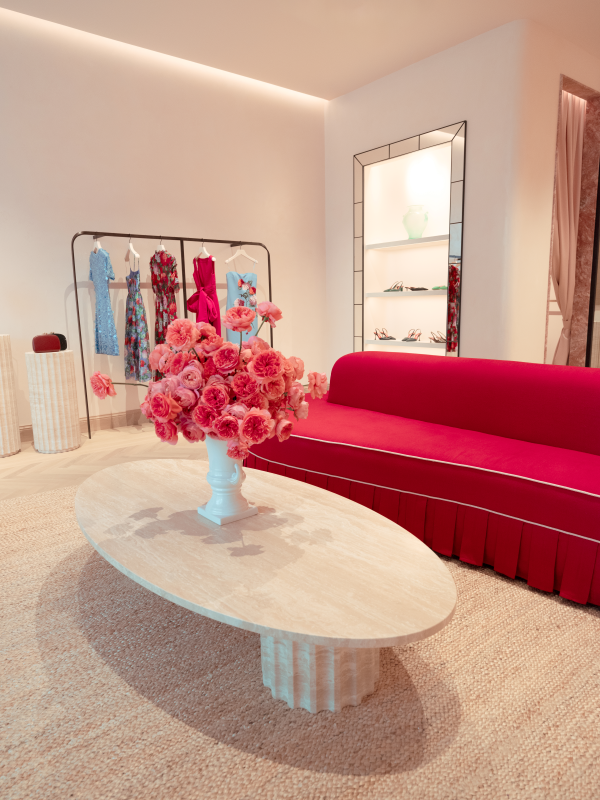
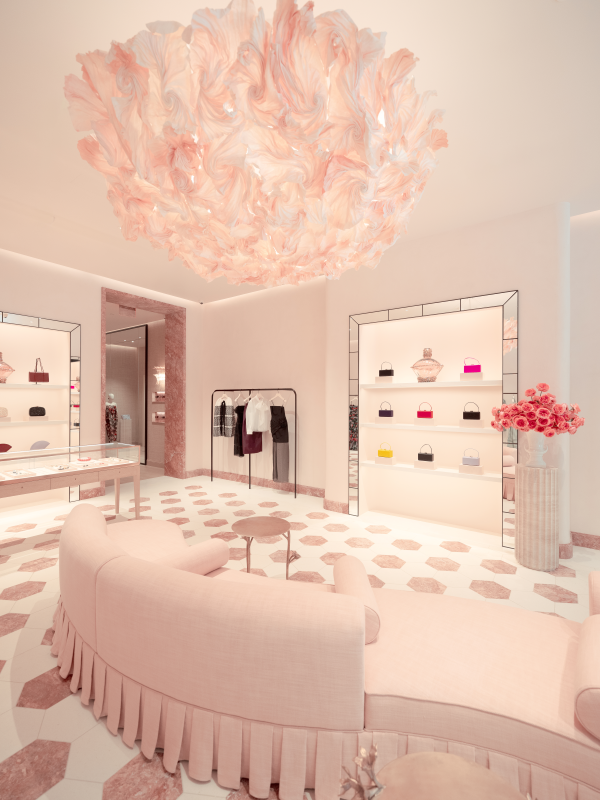
Inside the Carolina Herrera Miami Design District boutique, soft shades of pink meet vivid red accents, geometric flooring and sculptural furnishings.
However, the new boutique also reveals a more contemporary and art-driven interpretation of the Carolina Herrera universe. For those of us who have followed the House for decades, its interiors open an interesting conversation about how a fashion brand with such recognizable visual codes — from the impeccable white shirt to its structured, sophisticated elegance — continues to evolve for a new generation. In Miami, the result deliberately moves away from some of those historical references in favor of a more experimental language, where art, color, and interior design take on a much more prominent role.
A custom floor developed specifically for the Miami location combines white limestone with blush-pink travertine. Its naturally occurring rose tones add warmth while reinforcing one of the most recognizable aspects of the Carolina Herrera vocabulary: a fearless relationship with color.
Soft pink Venetian plaster mixed with shimmering mica adds luminosity to the walls, while travertine fixtures, tactile finishes and upholstered seating prevent the architectural sophistication from ever feeling cold.
Instead, the environment feels polished yet welcoming.
One of its central pieces is a custom serpentine sofa, whose curves anchor the boutique’s main salon. Throughout the space, specially designed furniture and fixtures borrow ideas from couture craftsmanship, essentially translating fashion construction into interior design.
That dialogue continues along a sculptural staircase wrapped in natural-fiber wall coverings, with marble display niches dedicated to eyewear.
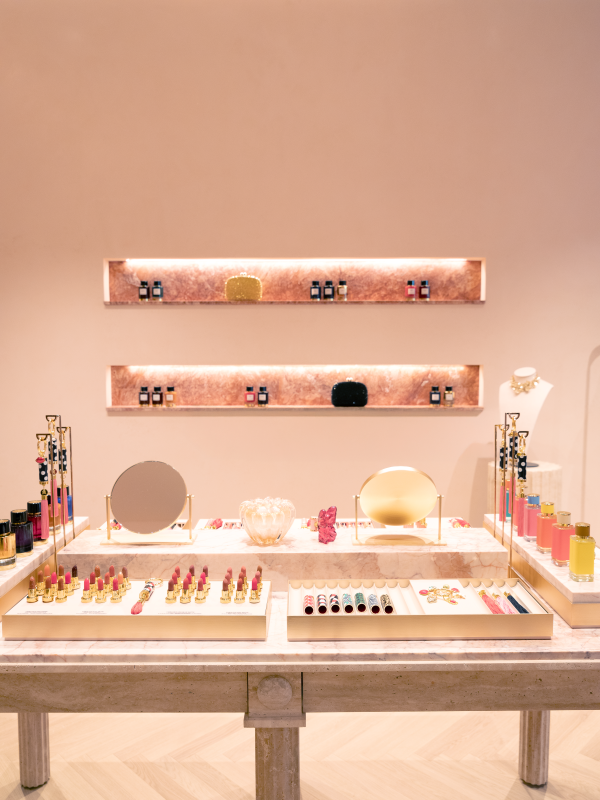
Upstairs, oak parquet flooring introduces another layer of warmth, while Carolina Herrera Beauty creates a natural transition from fashion into fragrance and beauty.
The Carolina Herrera Woman—and the Miami Connection
For Wes Gordon, there is a natural relationship between the personality of the Carolina Herrera woman and the personality of Miami.
He describes her as bold, elegant, joyful and confident, a woman who embraces color and understands the power of making an entrance.
Miami understands that language particularly well.
This is, after all, a city where minimalism and exuberance can comfortably share the same street; where fashion exists beside architecture, contemporary art and tropical color; and where getting dressed can still be treated as an occasion.
The Herrera woman belongs here.
Women in the Arts Becomes Part of the Boutique
Perhaps one of the most compelling elements of the new boutique is that its celebration of women extends beyond fashion.
As part of Carolina Herrera for Women in the Arts, the House’s ongoing platform supporting female-identifying creative talent, several women artists were commissioned to create original works for the Miami space.
Argentine artist Constanza Vallese developed an exclusive floral motif that appears throughout the boutique in sculptural tables, vases and decorative pieces.
The floral language feels particularly appropriate. Flowers have long existed within the visual world of Carolina Herrera, appearing in prints, embroideries, silhouettes and dramatic runway moments.
Here, they become part of the architecture.
Above the central salon, Los Angeles-based artist Liz Oliver created a dramatic textile installation influenced by organic shell forms. Soft sculptural draping gives the work movement while also referencing one of fashion’s most essential materials: fabric itself.
Designed specifically for the scale and proportions of the Miami boutique, the installation transforms what could simply have been a chandelier into a central art piece.
The House also commissioned ceramic planters from Choplet Ceramics, the Brooklyn-based all-women studio. Their handcrafted vessels introduce an organic quality into the space while extending the boutique’s larger celebration of women working across creative disciplines.
More Than a Fashion Boutique
The importance of the Miami Design District has always extended beyond the concentration of luxury brands found within its streets.
The neighborhood asks fashion houses to think architecturally.
Craig Robins, founder and CEO of Dacra and one of the driving forces behind the development of the Miami Design District, emphasized that the new Carolina Herrera boutique allows the House to express its identity through architecture, materials and design while bringing legacy and innovation together.
That may ultimately be what makes this opening particularly interesting.
Carolina Herrera did not simply place a collection inside a beautiful room.
The House created an environment around the woman who wears it.
Fashion, fragrance, handbags, beauty, art, furniture and architecture become parts of one conversation.
45 Years Later, Herrera Continues to Evolve
There is something poetic about Carolina Herrera celebrating its 45th anniversary with such a significant expansion in Miami.
The House has evolved considerably since Carolina Herrera presented her first collection in New York in 1981. Today, with Wes Gordon directing its creative vision, the brand continues to reinterpret its codes for new generations.
Yet certain ideas remain remarkably consistent.
Femininity.
Color.
Elegance.
Confidence.
And clothes that understand the value of making an entrance.
For those of us with Venezuelan roots, there is another layer to the story.
Long before fashion became as globally connected as it is today, Carolina Herrera gave Venezuelan women who loved fashion someone to look toward on the international stage. Her career demonstrated that sophistication did not require abandoning identity and that elegance could become its own form of personal signature.
Her iconic white shirts perhaps explain it best.
They are simple, but never ordinary.
And decades later, we are still wearing them.
Now, surrounded by the art, architecture and unmistakable energy of the Miami Design District, the Carolina Herrera story begins another chapter—one that feels very much at home in Miami.
For more about the brand, please visit: Carolinaherrera.com/us/en
Photo Credits: Carolina Herrera | Courtesy of Gnazzo Group.
Carolina Herrera Miami Design District
127 NE 41st Street
Miami, Florida 33137
Hours:
Monday–Saturday: 11:00 AM–7:00 PM
Sunday: 12:00 PM–6:00 PM
Telephone: 786-883-0050
“Carolina Herrera reminds us that true elegance is not about following trends—it is about creating a signature so timeless, the world recognizes it before you even say your name.”
–Miami Fashion Spotlight
Spanish Version